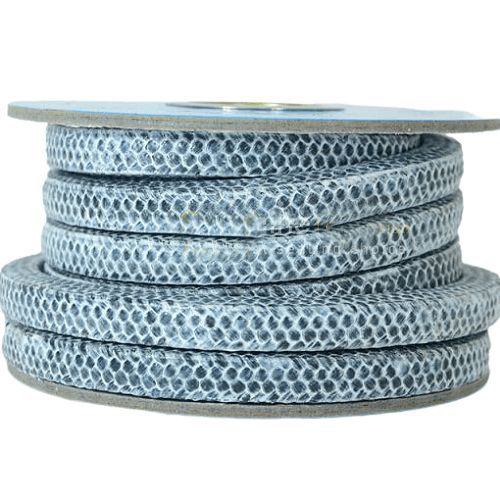
Carbon Gland Packing
Premium Carbon Gland Packing for Industrial Applications
Carbon Gland Packing is an essential sealing solution designed for demanding industrial environments. Engineered with high-quality carbon fibers and reinforced materials, our packing offers superior performance in high-pressure, high-temperature applications. The unique braided structure ensures excellent resilience and long service life while maintaining effective fluid containment.
Key Product Specifications
- Material Composition: 85-90% carbon fiber, 10-15% PTFE lubricant
- Temperature Range: -100°F to +750°F (-73°C to +399°C)
- Pressure Rating: Up to 3000 psi (207 bar)
- Chemical Resistance: Excellent resistance to acids, alkalis, and solvents
- Standard Sizes: 1/4" to 1" (6mm to 25mm) diameter
- Density: 80-85 lbs/ft³ (1280-1360 kg/m³)
- Color: Black with graphite sheen
Performance Comparison
| Feature | Carbon Gland Packing | Traditional Packing |
|---|---|---|
| Thermal Conductivity | High (excellent heat dissipation) | Low to moderate |
| Compressibility | 15-20% | 25-30% |
| Break-in Period | Minimal (1-2 hours) | Extended (8-24 hours) |
| Service Life | 3-5 times longer | Standard |
| Friction Coefficient | 0.08-0.12 | 0.15-0.30 |
Carbon Gland Packing FAQ Section
Q: What makes Carbon Gland Packing superior to traditional packing materials?
A: Carbon Gland Packing offers several advantages including higher temperature tolerance, better chemical resistance, reduced friction, and longer service life. The carbon fiber construction provides exceptional strength while the PTFE impregnation ensures smooth operation with minimal shaft wear.
Q: How should Carbon Gland Packing be installed for optimal performance?
A: For best results, install Carbon Gland Packing in clean, staggered rings with joints offset by 90-120 degrees. Apply proper gland compression (typically 15-20% of cross-section) and run a brief break-in period at lower pressure. Never over-tighten as this can reduce packing life and increase shaft wear.
Q: What types of pumps and valves are most suitable for Carbon Gland Packing?
A: Carbon Gland Packing performs exceptionally well in centrifugal pumps, mixers, agitators, and control valves handling abrasive fluids, high temperatures, or corrosive chemicals. It's particularly recommended for boiler feed pumps, chemical process pumps, and steam applications where conventional packings fail prematurely.
Customization Options
Our Carbon Gland Packing can be customized to meet specific operational requirements:
- Special weave patterns for enhanced sealing characteristics
- Custom PTFE content (5-20%) for varying lubrication needs
- Anti-extrusion rings for high-pressure applications
- FDA-compliant versions for food and pharmaceutical use
- Conductive variants for explosive environments
Technical Advantages
The Carbon Gland Packing system provides several technical benefits that translate to operational savings:
- Reduced maintenance downtime due to extended service intervals
- Lower energy consumption from decreased friction
- Minimal shaft/sleeve wear through optimized surface contact
- Consistent performance across wide temperature fluctuations
- Environmental compliance with reduced leakage rates
Carbon Gland Packing FAQ Section Continued
Q: Can Carbon Gland Packing be used in food processing equipment?
A: Yes, we offer FDA-compliant versions of Carbon Gland Packing that meet 21 CFR 177.2600 standards for incidental food contact. These variants use food-grade lubricants and processing aids while maintaining all the performance characteristics of standard carbon packing.
Q: How does temperature affect Carbon Gland Packing performance?
A: Unlike conventional packings that degrade at high temperatures, Carbon Gland Packing maintains its structural integrity across its rated range. The carbon fibers actually improve sealing at elevated temperatures while the PTFE content ensures proper lubrication throughout the temperature spectrum.
Q: What maintenance schedule is recommended for Carbon Gland Packing?
A> Carbon Gland Packing typically requires adjustment every 3-6 months depending on service conditions, compared to monthly adjustments needed with conventional packings. Complete replacement is generally needed after 12-24 months of continuous service, representing a significant improvement over traditional materials.
Industry Applications
| Industry | Typical Applications | Benefits Realized |
|---|---|---|
| Oil & Gas | Pump seals, valve stems, compressors | Reduced fugitive emissions, high-THP performance |
| Chemical Processing | Agitators, reactor seals, transfer pumps | Corrosion resistance, minimal product contamination |
| Power Generation | Boiler feed pumps, turbine seals | Steam compatibility, long service life |
| Water Treatment | Slurry pumps, mixers | Abrasion resistance, zero product dilution |
| Pulp & Paper | Digester pumps, washers | Chemical resistance, reduced downtime |
Installation Guidelines
- Clean the stuffing box thoroughly, removing old packing and debris
- Measure shaft/sleeve diameter and packing cross-section accurately
- Cut packing rings to exact length (wrap-around method recommended)
- Install rings with staggered joints (90° minimum offset)
- Apply initial compression per manufacturer specifications
- Gradually tighten after brief operation period
- Monitor leakage and temperature during break-in (2-4 hours)
- Adjust final compression after thermal stabilization
For technical assistance with your Carbon Gland Packing selection or installation, consult our engineering team who can provide application-specific recommendations based on your operating parameters and performance requirements.